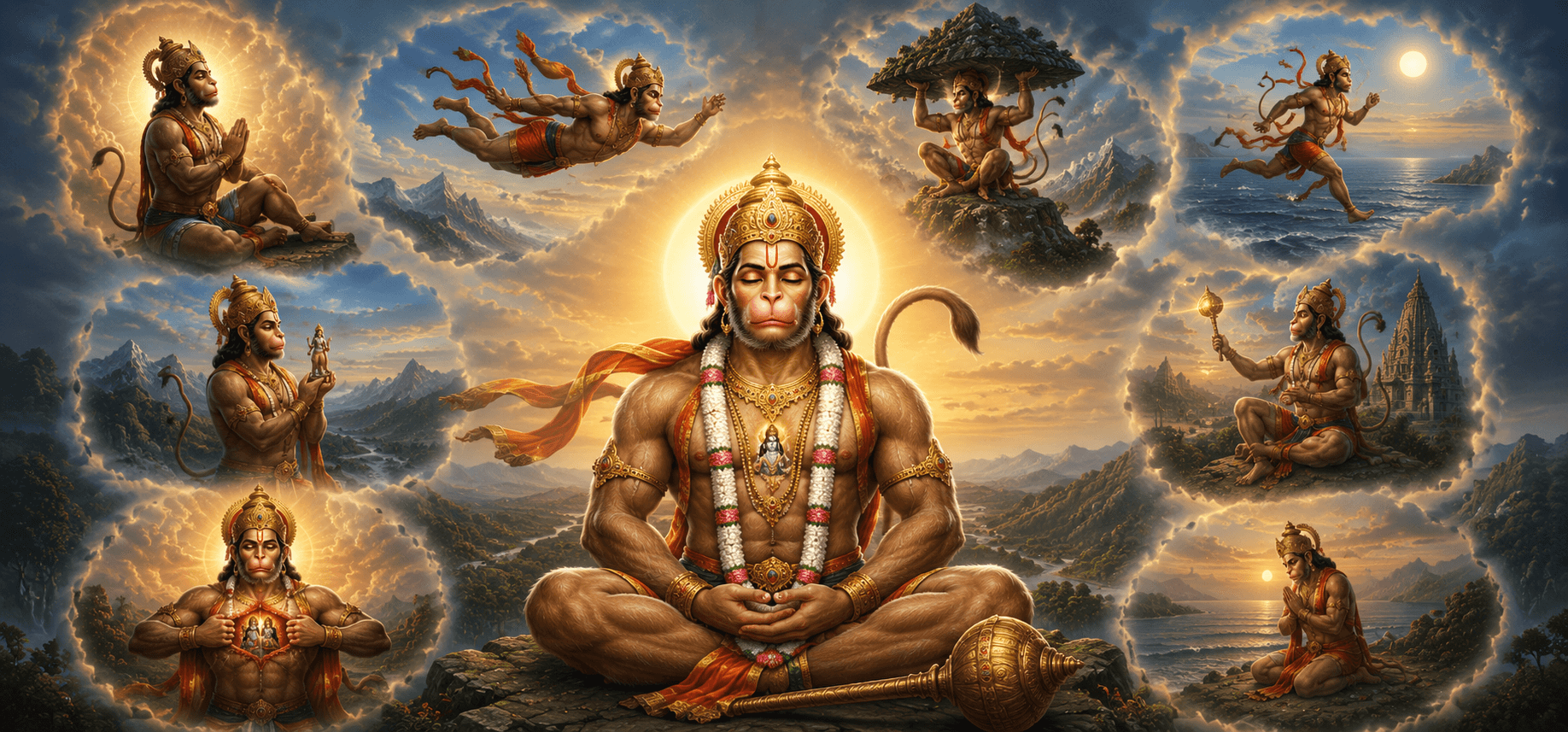
Introduction: Finding Strength Through Lord Hanuman
Arjun sat alone in his hostel room the night before his final exam. His hands were cold. His mind kept repeating one thought: "What if I fail again?" He had studied for months, but fear was eating his confidence. He called his grandmother, hoping she would comfort him. Instead, she told him a story.
She reminded him of the moment when Lord Hanuman stood at the edge of the ocean. The sea between him and Lanka was vast. The other vanaras doubted. Even Hanuman had forgotten his own strength. Then Jambavan spoke to him and reminded him of who he truly was. Hanuman remembered his power, grew in size, and leapt across the ocean in a single jump.
"Beta," she said, "your problem is not the exam. Your problem is that you have forgotten your own strength. Remember Hanuman ji. Fold your hands, take his name, and give your best." That night, Arjun slept peacefully. The next morning, he walked into the exam hall with a calm mind — and he did well.
This is what Lord Hanuman does for millions of people. He is not only a deity of physical strength. He represents courage, devotion, discipline, humility, and selfless service. When we feel small, his story reminds us that great strength is already inside us. It only needs to wake up.
In this article, we will understand the famous 8 powers of Lord Hanuman, known as Ashta Siddhi, and the 9 divine treasures, known as Nava Nidhi. We will learn their simple meanings, their spiritual message, and the practical Hanuman life lessons we can use every day.
Who Is Lord Hanuman?
Lord Hanuman is one of the most loved deities in Hindu tradition. He is the son of Vayu, the wind god, and Mata Anjani. He is best known as the greatest devotee of Lord Rama. His story is told in the Ramayana, where his courage, wisdom, and devotion shine in every chapter.
What makes Hanuman special is not only his power. It is the way he uses his power. He can leap across oceans, lift mountains, and defeat mighty warriors. Yet he never uses his strength for pride or personal gain. Every action of his is an offering to Lord Rama. This is why devotees see him as the perfect example of shakti (strength) joined with bhakti (devotion).
For students, he is a symbol of focus and fearlessness. For working people, he is a symbol of duty and loyalty. For families, he is a protector. For spiritual seekers, he is the ideal servant of the Divine. In simple words, Lord Hanuman shows us how to be strong and humble at the same time.
What Does “Ashta Siddhi Nava Nidhi Ke Data” Mean?
Anyone who recites the Hanuman Chalisa knows this beautiful line:
अष्ट सिद्धि नव निधि के दाता
Ashta Siddhi Nava Nidhi Ke Data — "Giver of the eight siddhis and nine nidhis"
Let us understand this Hanuman Chalisa meaning in simple words:
Ashta Siddhi means eight spiritual powers. In yogic and devotional tradition, these are special abilities that come through deep spiritual practice and divine grace. Lord Hanuman is believed to possess all eight of them.
Nava Nidhi means nine treasures or nine divine blessings. These are traditionally connected with wealth, abundance, and prosperity in devotional belief.
According to tradition, Mata Sita blessed Hanuman with the power to grant these siddhis and nidhis to sincere devotees. So the line tells us that Hanuman is not only powerful himself — he is also the giver of powers and blessings to those who worship with a pure heart.
One important point of accuracy: many people casually say "the 9 powers of Hanuman," but this is not correct. The siddhis are eight, and the nidhis are nine. The siddhis are spiritual powers, while the nidhis are treasures or blessings. Keeping this difference clear helps us respect the tradition properly.
The 8 Powers of Lord Hanuman: Ashta Siddhi
Here are the spiritual powers of Hanuman as remembered in devotional tradition. For each one, we will see its simple meaning, its spiritual lesson, and a practical lesson for modern life. Interpretations can differ slightly between traditions and teachers, and that is perfectly natural.
1 Anima Siddhi
Simple meaning
Anima is the power to become extremely small — smaller than the smallest particle. Tradition says Hanuman used a tiny form when he quietly entered Lanka at night to search for Mata Sita.
Spiritual lesson
Anima teaches humility. True greatness knows how to become small. When the ego shrinks, the soul can enter places that pride can never reach.
Modern life lesson
In family, at work, and in learning, humility opens doors. A humble person listens, learns from anyone, admits mistakes, and stays approachable. Leaders who can "become small" — who serve their teams instead of showing off — earn real respect.
2 Mahima Siddhi
Simple meaning
Mahima is the power to become extremely large. Devotees remember how Hanuman took a gigantic form while crossing the ocean and while facing mighty enemies.
Spiritual lesson
Mahima points to the inner greatness that lives in every soul. When faith awakens, a person can rise far beyond their normal limits.
Modern life lesson
We grow big not by boasting, but by courage, discipline, and good character. When a challenge is big, we must grow bigger than the challenge — with more effort, more patience, and more self-belief.
3 Garima Siddhi
Simple meaning
Garima is the power to become extremely heavy — so heavy that no force can move you.
Spiritual lesson
Garima stands for stability and grounded strength. A devotee with deep faith cannot be shaken by fear, temptation, or criticism.
Modern life lesson
Strong values make a person "heavy" in the best way. When problems come — failure, gossip, pressure, loss — a person rooted in honesty and faith stays steady. Be so grounded in your principles that no storm can move you.
4 Laghima Siddhi
Simple meaning
Laghima is the power to become extremely light — light enough to fly. Hanuman's flight across the ocean is the most loved image of this power.
Spiritual lesson
Laghima teaches freedom from heaviness of the mind — ego, fear, jealousy, and old grudges. A light heart rises easily toward God.
Modern life lesson
Let go of what weighs you down. Forgive people, release past failures, stop carrying unnecessary worries. A person who travels light through life feels peaceful, sleeps well, and moves faster toward their goals.
5 Prapti Siddhi
Simple meaning
Prapti is the power to reach any place and obtain whatever is truly needed.
Spiritual lesson
Prapti reflects focus, devotion, and right effort. When the goal is pure and the effort is sincere, the path opens. Hanuman found Mata Sita because he refused to stop searching.
Modern life lesson
Goals are reached through disciplined, steady work — not luck. Students who study daily, workers who improve their skills, and families who plan patiently all practise a form of Prapti. Keep your aim clear and keep moving.
6 Prakamya Siddhi
Simple meaning
Prakamya is the power of strong will — the ability to fulfil one's true wishes without obstruction.
Spiritual lesson
Prakamya teaches pure intention and determination. A wish backed by a clean heart and unshakable will carries divine force.
Modern life lesson
Willpower is a muscle. Students preparing for exams, professionals building careers, parents raising children — all succeed through determined, honest intention. Decide clearly, want it sincerely, and refuse to give up.
7 Ishitva Siddhi
Simple meaning
Ishitva is the power of lordship or mastery — a divine form of authority over nature and situations.
Spiritual lesson
Real authority comes with responsibility and humility. Hanuman had command over immense power, yet he always called himself a servant of Rama. Mastery without humility becomes arrogance.
Modern life lesson
True leadership means serving others, not showing power. A good manager lifts the team. A good parent guides with love. A good leader takes responsibility in failure and shares credit in success. Lead like Hanuman — powerful, yet bowed in service.
8 Vashitva Siddhi
Simple meaning
Vashitva is the power of control and influence — the ability to bring the mind, the senses, and situations under command.
Spiritual lesson
The highest control is self-control. Hanuman is celebrated for his perfect mastery over anger, ego, fear, and desire. A person who has conquered themselves can positively influence the whole world around them.
Modern life lesson
Self-control is the foundation of every success — in studies, career, health, money, and relationships. Control your screen time, your temper, your words, and your habits, and life slowly comes under your command.
The 9 Divine Treasures: Nava Nidhi
Nava Nidhi means the nine divine treasures. In devotional tradition, these treasures are associated with Kubera, the lord of wealth, and Lord Hanuman is remembered as the one who can bless devotees with them. Their exact meanings vary across traditions and texts, so devotees often understand them symbolically — as blessings of prosperity, wisdom, peace, protection, and inner abundance rather than only material riches.
Here are the nine nidhis with their simple symbolic meanings:
Mahapadma: The great lotus treasure — a symbol of the highest prosperity joined with purity, like a lotus that stays clean even in muddy water.
Padma: The lotus treasure — a symbol of wealth that blooms gracefully, along with beauty, growth, and a generous heart.
Shankha: The conch treasure — a symbol of fame, positive energy, and auspicious beginnings, like the sacred sound of the conch that removes negativity.
Makara: The crocodile treasure — a symbol of strength, security, and protection of what one has rightfully earned.
Kachhapa: The tortoise treasure — a symbol of patience, stability, and wisely guarded wealth, like a tortoise that moves slowly but steadily and protects itself well.
Mukunda: A treasure connected with joy and the finer things of life — a symbol of happiness, art, music, and contentment beyond money.
Kunda: A treasure often linked with the jasmine flower — a symbol of purity, freshness, and blessings that keep life fragrant and pleasant.
Nila: The sapphire-blue treasure — a symbol of rare good fortune and the deep, calm richness of a peaceful mind.
Kharva: A treasure whose meaning differs across traditions — often understood as a reminder of balance and humility, teaching that abundance must be handled with wisdom and simplicity.
Taken together, the Nava Nidhi teach one beautiful message: true wealth is complete only when outer prosperity is balanced with inner richness — peace, wisdom, gratitude, and devotion.
Quick Comparison: 8 Siddhis and 9 Nidhis
Concept | Meaning | Spiritual Message | Life Lesson |
|---|---|---|---|
Ashta Siddhi | 8 spiritual powers | Strength with devotion | Use power with discipline and humility |
Nava Nidhi | 9 divine treasures or blessings | Inner and outer abundance | True wealth includes wisdom, peace, values, and service |
Life Lessons from Lord Hanuman’s Powers
When we look at all the powers of Lord Hanuman together, a clear pattern appears. Every power is balanced by a virtue:
Courage: Hanuman leapt across the ocean when everyone else hesitated. Fear is natural, but faith is stronger. Take the leap your life is asking for.
Devotion: Every power Hanuman had was used in service of Lord Rama. Skill without purpose is empty. Connect your abilities to something higher than yourself.
Humility: The one who could grow as large as a mountain chose to sit at the feet of his Lord. The greater your strength, the deeper your bow should be.
Self-control: Hanuman was never a slave to anger, pride, or desire. Master yourself first; everything else becomes easier.
Discipline and focus: His search for Mata Sita never lost direction. One clear goal, pursued with steady effort, achieves more than a hundred scattered wishes.
Service and faith: Hanuman never asked, "What will I get?" He only asked, "How can I serve?" A life of service is a life of meaning.
How Lord Hanuman’s Qualities Help in Modern Life
For students: Hanuman inspiration is perfect for exam time. His focus teaches concentration, his courage removes fear of failure, and his discipline builds daily study habits. Many students recite the Hanuman Chalisa before exams to calm the mind and gather confidence.
For working professionals: Hanuman shows what loyalty, duty, and excellence look like. He completed every task fully — not halfway. He respected his seniors, supported his team, and never let success create pride. These are timeless workplace values.
For families: Hanuman's protective nature comforts households. His patience teaches parents, his obedience and respect inspire children, and his selfless love strengthens family bonds.
For leaders: Ishitva and Vashitva together define ideal leadership — mastery over the situation and mastery over oneself. A leader who serves, stays humble, and controls their temper builds trust that lasts.
For anyone facing fear or self-doubt: Remember the ocean scene. Hanuman's strength was always inside him; he had only forgotten it. So often, our biggest barrier is not the problem outside but the doubt inside. Devotion, prayer, and remembering our true worth can reawaken our strength.
Common Misunderstandings About Hanuman’s Powers
"The siddhis are just magic tricks." In devotional tradition, the siddhis are sacred abilities born of tapasya and divine grace — but their deeper purpose is spiritual. Saints have long taught that the true value of the siddhis lies in the qualities behind them: humility, self-control, focus, and surrender. Reading them only as magic misses their heart.
"Hanuman has 9 powers." This is a common mix-up. The powers (siddhis) are eight; the treasures (nidhis) are nine. The Chalisa line clearly separates them: Ashta Siddhi (eight) and Nava Nidhi (nine).
"Nava Nidhi means only money." The nidhis include material prosperity, but tradition also treats them as symbols of complete abundance — peace of mind, wisdom, protection, joy, and spiritual richness.
"These are scientific claims." The siddhis and nidhis belong to spiritual and devotional tradition, not to science. They are matters of faith, symbolism, and inner transformation, and they should be respected as such.
"Worship replaces effort." Hanuman himself is the answer to this. He had divine powers, yet he still swam through effort — searching, fighting, serving, never resting until the task was done. Devotion and hard work walk together; one never replaces the other.
Conclusion
The 8 powers of Lord Hanuman and the 9 divine treasures are not just ancient concepts to memorise. They are a complete map for a strong and beautiful life. Anima teaches us to stay humble. Mahima reminds us of our inner greatness. Garima grounds us in values. Laghima frees us from mental burden. Prapti and Prakamya push us toward our goals with focus and willpower. Ishitva shows us leadership through service, and Vashitva gives us the greatest victory of all — victory over ourselves. The Nava Nidhi complete the picture by teaching that real wealth is both outer and inner.
Lord Hanuman's true power was never only in his muscles. It was in his devotion, his discipline, his humility, his wisdom, and his endless spirit of service. That is why, centuries later, one line from the Hanuman Chalisa — Ashta Siddhi Nava Nidhi Ke Data — still fills millions of hearts with strength.
The next time fear, doubt, or failure stands before you like an ocean, remember Hanuman at the shore. Your strength is already within you. Fold your hands, remember him, and take the leap.
Jai Shri Ram. Jai Hanuman.
FAQs
1. What are the 8 powers of Lord Hanuman?
The 8 powers, called Ashta Siddhi, are Anima (becoming very small), Mahima (becoming very large), Garima (becoming very heavy), Laghima (becoming very light), Prapti (reaching or obtaining anything needed), Prakamya (fulfilment of strong will), Ishitva (mastery or lordship), and Vashitva (control and influence).
2. What does Ashta Siddhi mean?
Ashta means "eight" and Siddhi means "spiritual power" or "accomplishment." So Ashta Siddhi means the eight spiritual powers that, in yogic and devotional tradition, come through deep spiritual practice and divine grace.
3. What does Nava Nidhi mean?
Nava means "nine" and Nidhi means "treasure." Nava Nidhi means the nine divine treasures or blessings, traditionally connected with prosperity, abundance, and complete well-being — both material and spiritual.
4. Are the 9 Nidhis powers?
No. The nidhis are usually understood as treasures or blessings, not powers. The powers are the eight siddhis. The Hanuman Chalisa keeps them separate: eight siddhis and nine nidhis.
5. Why is Lord Hanuman considered powerful?
Because he combines every kind of strength: physical power, spiritual power, sharp intelligence, complete self-control, and unshakable devotion. Tradition also holds that he was blessed by many gods and by Mata Sita, and that he can grant the siddhis and nidhis to sincere devotees.
6. What can students learn from Lord Hanuman?
Students can learn focus, courage before exams, discipline in daily study, humility while learning, and self-control over distractions. Hanuman shows that steady effort with a calm, devoted mind brings success.
7. What can working professionals learn from Lord Hanuman?
Professionals can learn loyalty, complete dedication to every task, teamwork, respect for others, calmness under pressure, and leadership through service instead of ego.
8. What is the biggest lesson from Hanuman’s life?
That great power becomes truly great only when it is joined with humility and devotion. Hanuman had every power imaginable, yet he lived as a humble servant — and that humility made him immortal in the hearts of devotees.
9. Is Hanuman’s power only physical strength?
Not at all. Hanuman also represents devotion, wisdom, self-discipline, humility, courage, and selfless service. In fact, devotees value these inner qualities even more than his physical strength.
10. Does this article need fact-checking?
Yes. Names, meanings, and interpretations of Ashta Siddhi and Nava Nidhi should be checked with reliable spiritual sources before publishing, since interpretations can vary across traditions, texts, and teachers.
0 comments